
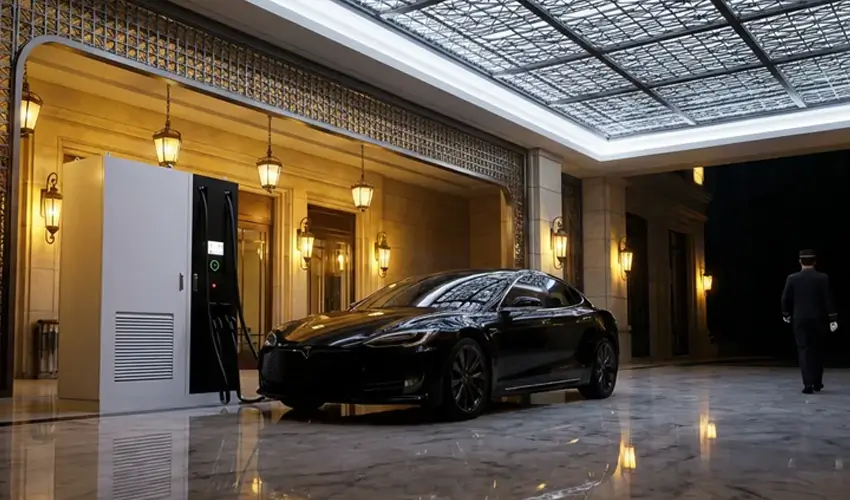
EV charging at hotels is no longer a nice-to-have—it directly impacts occupancy rates, guest experience, and long-term asset value. The real challenge isn’t whether to install it, but how to balance power capacity, utilization, and scalability in a way that actually works. In the following, ZECONEX draws on years of hands-on engineering experience to break down what truly delivers in real-world deployments.
Why Hotels Are Rapidly Expanding EV Charging Infrastructure?
1. Growing Demand for Electric Vehicle Travel
As electric vehicles become mainstream, more travelers are hitting the road in EVs—and they’re choosing hotels where both they and their cars can “stay overnight.” This subtle shift is quietly redefining how guests judge a hotel.
2. Changing Guest Expectations
Not all guests expect the same when it comes to charging. At upscale hotels, EV charging is seen as a baseline—if it’s missing, something feels off. At budget properties, it’s a pleasant surprise that makes guests feel the hotel “gets” them. Either way, charging availability is starting to influence where people choose to spend their money.
3. A Competitive Edge for Hotels
The impact is already showing up in both visibility and revenue. EV charging filters on OTA platforms are splitting hotels into two groups: those that get seen, and those that get skipped. And once guests check in with an EV, their dwell time naturally extends—those extra hours often translate into additional spend on dining, meetings, or retail.
Which Type of EV Charging Should Hotels Choose?
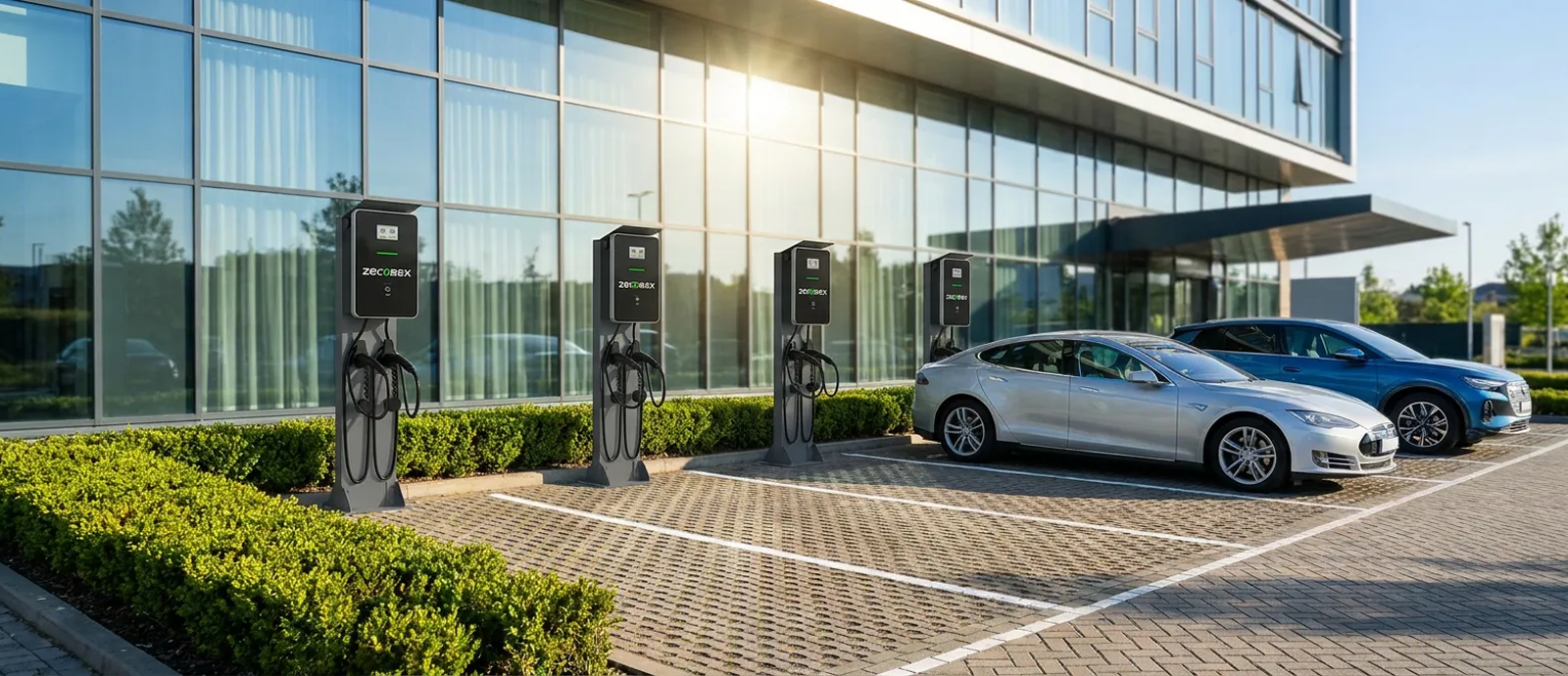
1. Level 2 Chargers: Core Overnight Charging
For today’s hotels, deploying a 7–22 kW Level 2 charging network is a cost-controlled infrastructure investment with clear upside in guest demand.
The business logic is straightforward: meet the basic overnight charging needs of guests, and give your property one more reason to be chosen—without significantly increasing operational burden.
2. DC Fast Chargers: High Turnover
If AC charging covers overnight guests, DC fast charging is a revenue play for incremental traffic. It targets drivers who stop briefly, top up quickly, and move on—they may not book a room, but they will spend on coffee or a meal. For hotels near highways, airports, or business districts, a fast charger becomes a new customer acquisition point.
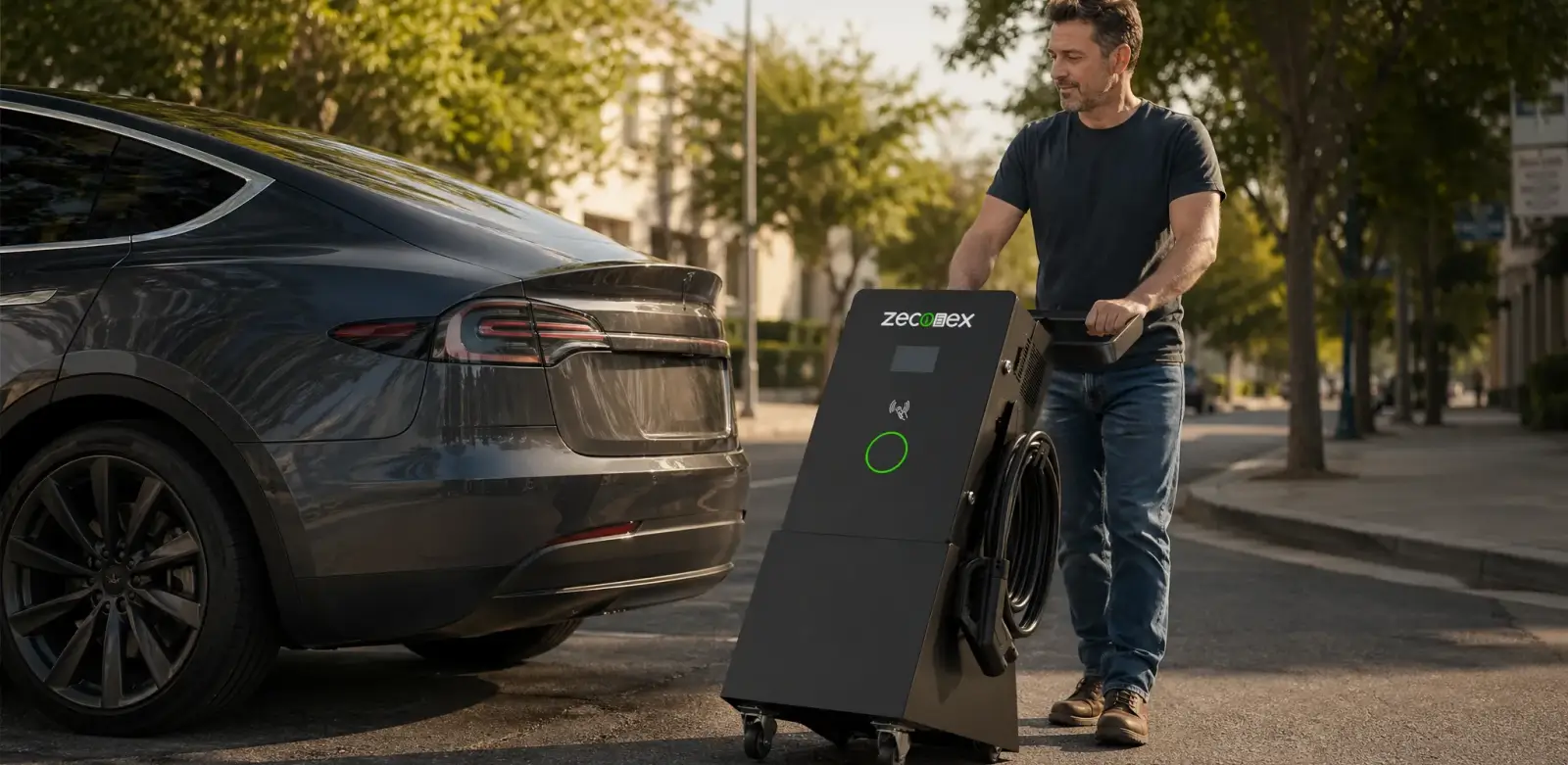
3. Portable Chargers: Flexible Deployment Needs
For hotels where retrofitting is difficult or grid capacity is limited, mobile DC charging is emerging as a practical complement. It’s not a replacement for fixed infrastructure, but a flexible way to handle peak demand and temporary scenarios—busy weekends, major events, or sudden spikes in usage.
ZECONEX’s mobile energy storage system integrates lithium iron phosphate batteries with a DC charging module, enabling off-grid operation and rapid deployment.
What Does It Cost to Install EV Charging at a Hotel?
1. Equipment Costs
Charging hardware is typically the least expensive part of the overall project.
Type | Power Rating | Unit Price Range (USD) |
AC Charger | 7 kW | $500–$1,500 |
AC Charger | 22 kW (three-phase) | $1,500–$3,500 |
DC Fast Charger | 30 kW (wall-mounted) | $3,000–$6,000 |
DC Fast Charger | 60 kW | $20,000–$35,000 |
DC Fast Charger | 120 kW | $55,000–$80,000 |
2. Installation Costs
This is typically the most expensive part of the project.
Item | Cost Range (USD) | Notes |
AC Charger Installation | ≈ $2,500 per port | Includes basic wiring and commissioning |
DC Charger Installation + Grid Connection | $20,000–$60,000 per port | Excludes transformer upgrades |
Transformer Upgrade | Six-figure add-on | Triggered when high-voltage side upgrades are needed |
Trenching & Cable Laying | $75–$150 per foot | Costs scale linearly with distance |
Civil Works (foundation/bollards/signage) | $20,000–$50,000 | Includes ADA-compliant design |
3. Operating Costs
Cost Category | Annual Cost Range (USD) | Notes |
Electricity | $0.10–$0.30 per kWh | Commercial rates; DC sites must watch demand charges—simultaneous peak usage can trigger higher tariffs |
Maintenance | $600–$2,400 per charger | ~80% of maintenance costs are typically concentrated in 20% of units |
Platform / Software | $280–$650 per port | OCPP-based systems allow backend flexibility; closed protocols limit pricing leverage |
Note: The figures above reflect current global market benchmarks. Actual budgets should be based on site-specific conditions and available electrical capacity, with a proper engineering assessment.
Best EV Charging Solution for Hotels
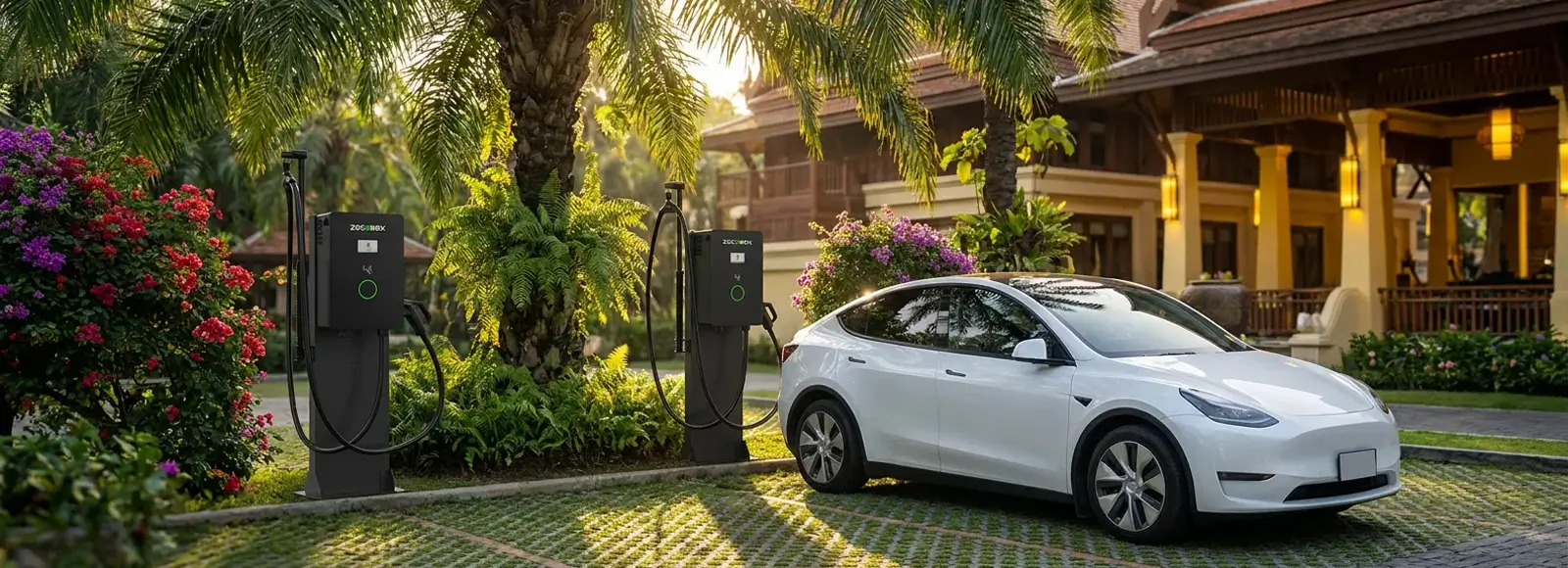
Hotels don’t need to design charging infrastructure from scratch—the real need is a solution that aligns with property size and guest profile. Below are recommended configurations by scale, from budget-limited small hotels to large properties requiring scalable systems.
Small Hotels: Start Small
- Recommended Setup: 2–4 AC chargers (7–22 kW), with an optional mobile charger as backup.
- Core Strategy: Prioritize coverage.
Deploying 2–4 AC chargers is usually enough to meet basic guest charging needs while keeping electrical upgrades and upfront investment within a reasonable range.
Adding a mobile DC charger provides flexible, on-demand capacity—low cost, but highly effective in preventing a poor guest experience during unexpected spikes in demand.
Medium Hotels: Adding a Fast-Charging Layer
- Recommended Setup: An AC charging network + 1 DC fast charger (30–60 kW)
- Core Strategy: Two speeds, one system.
Mid-sized hotels typically serve both overnight guests and short-stay travelers. The AC network ensures baseline coverage, while adding a DC fast charger creates a dedicated fast-turnover channel.
In terms of selection, a 30–60 kW DC charger is sufficient for most fast-charging scenarios without the added cost burden of higher-power systems.
Large Hotels: Building a Scalable System
- Recommended Setup: AC charging infrastructure + multiple DC fast chargers + optional battery energy storage system (BESS).
- Core Strategy: Build a scalable charging system that uses energy storage to overcome grid capacity constraints.
For large hotels, electrical capacity is often the primary engineering bottleneck. On-site transformers are typically not designed with sufficient headroom for large-scale DC charging loads.
In this context, integrating a battery energy storage system is a critical engineering option—it buffers power demand through charge and discharge cycles, significantly reducing the impact of peak loads on the grid.
ZECONEX’s product portfolio, for example, includes a mobile energy storage system that integrates lithium iron phosphate batteries and a DC charging module. It supports off-grid operation and can be deployed in locations with limited grid capacity, enabling fast charging without immediate grid expansion.
For large hotels operating multiple DC chargers simultaneously, this approach can compress project timelines from a lengthy process involving grid upgrades, permitting, and construction into just a few weeks of equipment installation and commissioning—making it a meaningful engineering variable worth serious consideration.
Common Mistakes in Hotel EV Charging Deployment
Across hundreds of projects, we consistently see the same recurring failure patterns.
1. Mistaking Peak Capacity for Real-World Demand
The most common design mistake is allocating far more charging power to each parking space than is actually required. In practice, real-world data consistently show that for overnight hotel parking, a basic power range is sufficient in the vast majority of cases.
Equipping every parking space with fast-charging capability may sound like forward-thinking planning, but in reality, it simply increases costs and places unnecessary strain on the electrical infrastructure.
A more rational approach is to match charging capacity to actual guest parking duration and behavior patterns, rather than designing every space based on extreme assumptions.
2. Choosing Charging Equipment Without OCPP Support
Once this mistake is made, it’s not something you can fix with an add-on or a simple upgrade. Choosing closed-protocol chargers without OCPP support effectively locks the operator into a single-vendor ecosystem—one where the “keys” are controlled by the supplier.
Any engineer familiar with charging communication protocols knows this: the moment you want to switch backend platforms, introduce competing operators, or manage multiple brands under one system, migration costs escalate dramatically—and in some cases, the only realistic option is a full hardware replacement.
The real cost isn’t the upfront savings on procurement. It shows up later, every time you’re unable to change, upgrade, or integrate the system the way your operation actually needs.
3. Treating Free Charging as an Operating Strategy
Free charging does sound like a nice hospitality gesture—until guests leave their cars plugged in all day and treat your chargers like personal parking electricity stations. Once charging is priced at zero, user behavior often shifts from “charge and go” to “plug and stay.” Meanwhile, the hotel ends up absorbing the electricity costs, equipment depreciation, and guest complaints about unavailable chargers—all at once.
This isn’t about making a profit center. It’s about establishing a basic price anchor to guide usage behavior. Even a minimal fee that simply covers electricity costs is often enough to maintain turnover, manage expectations, and keep the system reliably available for all guests.
Conclusion: Is Investing in Hotel EV Charging Worth It?
The answer is yes—but only with a clearly defined operational strategy.
EV charging is not a direct profit center. It is an infrastructure investment that enhances asset attractiveness, reduces hidden guest loss caused by a lack of search visibility, and provides operational flexibility as EV penetration continues to grow.
Need the right charging solution for your hotel? Whether it’s AC coverage for small properties, multi-port DC deployment for large sites, or energy storage integration for grid-constrained locations, the ZECONEX engineering team can provide practical guidance on system selection and deployment based on real project experience. Contact us to get a tailored solution for your property.