
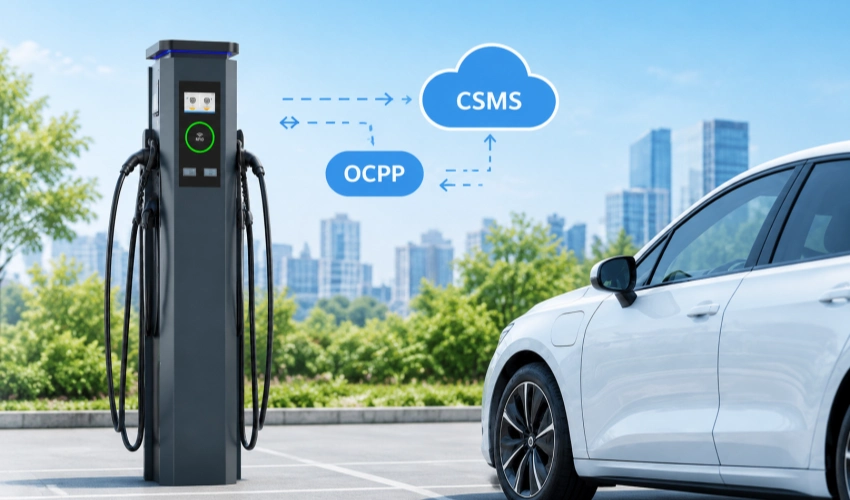
For charge point operators (CPOs), choosing an OCPP-compatible EV charger involves more than checking its protocol version. Compatibility also depends on protocol implementation, firmware, network settings, backend requirements, and supported functions. If these factors are overlooked, projects may face connection failures, limited functionality, or additional integration costs. Before bulk procurement, CPOs should verify technical requirements, prepare the integration environment, and test the charger with the intended management system.
OCPP Compatibility Requirements for CPOs
First, confirm the exact OCPP version, edition, and communication protocol supported by both the charger and the charging station management system (CSMS).
Check whether the supplier holds OCPP certification and verify the certified product, protocol version, and applicable functions. Certification does not replace project-level compatibility testing, as devices may implement different optional features. Request a model-specific feature list and ask the CSMS provider to confirm whether the charger meets the project's operational requirements.
Factors That May Affect OCPP Compatibility
Even when the charger and CSMS support the same OCPP version, device and system settings may affect connectivity. Common factors include the charger model, firmware version, WebSocket URL, charge point identity, network access permissions, DNS resolution, and security certificates. For encrypted connections, confirm that TLS and certificate requirements are also aligned.
Network connectivity requires careful attention. Wi-Fi, Ethernet, and 4G can provide IP connectivity, but signal quality, firewall rules, carrier networks, and access policies may affect connection stability. If a charger has network access but cannot establish an OCPP session, check the connection URL, authentication parameters, network policies, and protocol logs before concluding that the protocols are incompatible.
Firmware updates and backend configuration changes may also affect existing connections or functions. Confirm the firmware version, update process, and compatibility maintenance policy before procurement.
OCPP Functions and System Integration Requirements
CPOs should verify required OCPP functions rather than assume all compatible chargers offer identical capabilities. Key functions may include charger status reporting, user authorization, transaction records, meter values, remote start and stop, diagnostics, and configuration management. If a project requires smart charging, dynamic load balancing, remote firmware updates, or local authorization lists, confirm that both the charger and CSMS support the relevant functions.
For projects involving billing or multiple platforms, check whether transaction data and meter readings meet backend requirements. Payment platforms, roaming networks, and energy management systems may require additional interfaces or integration work. OCPP supports communication between chargers and central management systems; it does not automatically guarantee compatibility with every third-party platform.
What to Prepare Before OCPP Integration and Deployment
Before integration, CPOs should prepare the target CSMS name and version, required OCPP version, essential feature list, network requirements, and security conditions. Suppliers should provide the relevant model's datasheet, protocol feature list, available certification records, and firmware information. Both parties should clarify which functions are standard, optional, customized, or dependent on backend development.
Next, test the actual charger model with the intended CSMS. Testing should cover connectivity, authorization, status reporting, charging start and stop, transaction records, meter values, remote control, and fault recovery. Add test cases for project-specific requirements such as smart charging or remote updates, and define acceptance criteria in advance.
The Open Charge Alliance provides an OCPP Compliance Test Tool (OCTT) to assess protocol compliance. However, protocol conformance testing and integration testing with the target CSMS serve different purposes. Resolve outstanding issues and clarify technical support responsibilities before approving bulk deployment.
ZECONEX EV Charger Selection and Compatibility Validation
ZECONEX offers AC and DC charging solutions for different applications. Its published specifications for certain 7–22 kW commercial wallbox models list OCPP 1.6 JSON as standard and OCPP 2.0 as an option, with Wi-Fi and Ethernet support and optional 4G connectivity.