
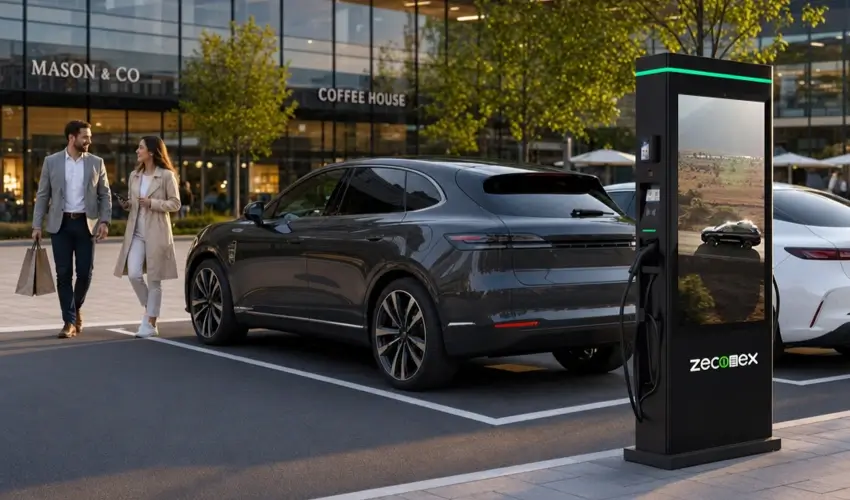
Across Europe and North America, public EV charging networks are scaling at record speed, yet consistent profitability remains one of the sector’s most pressing challenges. Rising grid costs, tariff competition and lengthening asset payback periods are driving operators to pursue incremental revenue streams beyond charging fees alone.
Each public charging station occupies high-dwell-time real estate, with drivers spending 20 to 45 minutes on-site per session—a captive audience that most infrastructure currently leaves untapped. Advertising-integrated chargers unlock this potential, redefining charging stations as dual-purpose digital assets through purpose-built display hardware, isolated system architecture, and cloud-based content operations.
2026: The Digital Business Era
Digitalization is redefining the value of public-facing physical infrastructure. Digital out-of-home (DOOH) advertising continues to expand across Western markets, driven by its ability to deliver targeted, context-rich brand exposure in high-traffic offline locations. At the same time, EV charging infrastructure is scaling rapidly across retail hubs, highway corridors and urban public zones, creating a growing network of fixed, high-dwell-time customer touchpoints.
In this context, EV chargers are no longer viewed solely as utility equipment. They are emerging as connected digital nodes that combine energy delivery with media and customer engagement capabilities. This shift aligns with broader trends in smart city and smart retail development, where infrastructure assets deliver multiple layers of value to operators, site hosts, and end users alike.
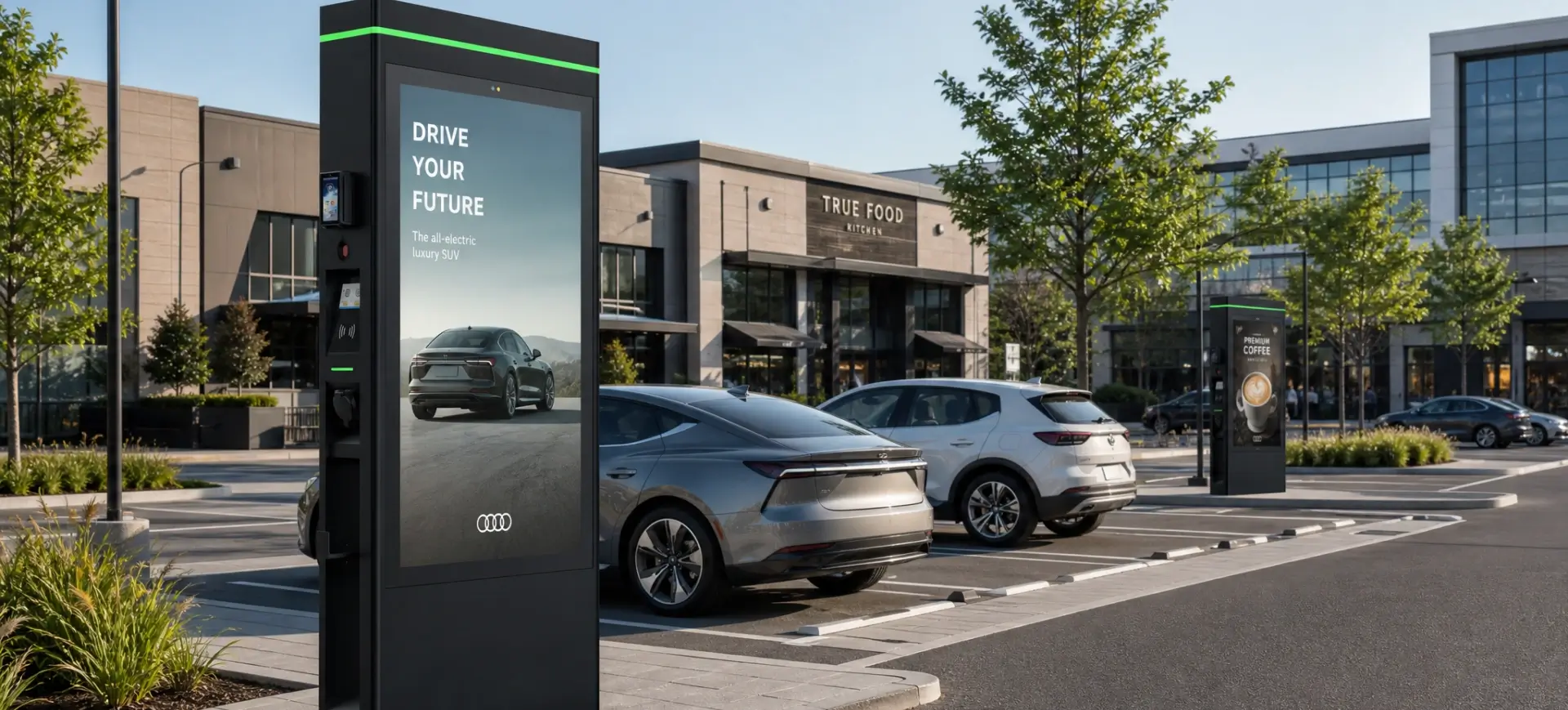
Digital Operations and Business Models for EV Charging
Revenue Constraints of Pure Charging Business Models
Traditional charging-only operations face well-documented profitability pressures. High upfront hardware and grid connection costs, volatile electricity prices, and competitive downward pressure on charging tariffs combine to lengthen project payback cycles for public charging sites. For many charge point operators, incremental revenue streams are critical to improving project ROI and justifying wider network expansion.
Digital Operations as a Profitability Lever
Forward-looking operators are adopting digital-first operational models to optimize both cost efficiency and revenue potential. Cloud-based charging management systems already enable remote monitoring, load balancing, and tariff management; extending this digital layer to include advertising and customer engagement creates a natural, low-marginal-cost revenue upgrade.
Core Advertising Monetization Models
Three dominant monetization models have emerged for advertising EV chargers in Western markets:
Third-party programmatic advertising: Operators sell screen inventory to brand advertisers on a CPM basis, generating passive revenue from high-traffic sites.
Site host brand promotion: For retail centres, fuel stations and leisure venues, chargers display on-site promotions, store announcements and loyalty offers to drive in-store spending.
Fleet and corporate campus communication: For private fleet depots and business parks, chargers serve as internal communication hubs for company announcements, safety messaging and brand education.
What Is an Advertising EV Charger?
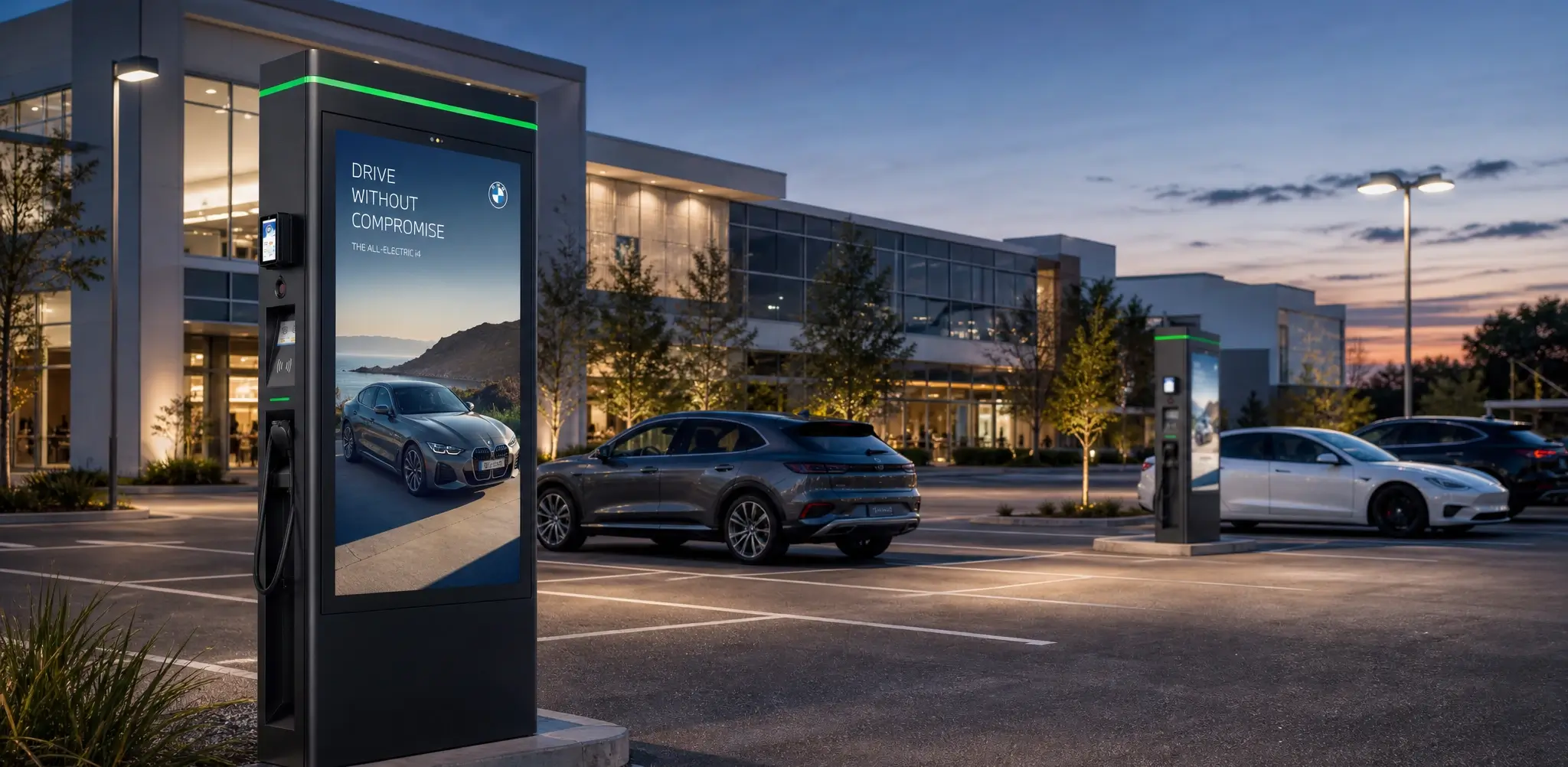
An advertising EV charger is a commercial-grade charging unit integrated with a high-brightness outdoor digital display, designed to deliver reliable AC or DC charging while simultaneously running digital advertising, informational, or promotional content.
Unlike standard chargers with small status screens, advertising chargers feature large-format displays (typically 43 to 55 inches) built for 24/7 outdoor operation. They are deployed in locations with sustained foot traffic and dwell time, including supermarket parking lots, highway service plazas, urban public parking garages, and fuel retail sites.
The core value proposition is straightforward: the same physical footprint that delivers charging revenue also generates media revenue, improving overall asset utilization and per-site returns without requiring additional land or grid capacity.
How Do EV Chargers Display Advertisements? A Look at Technical Architecture
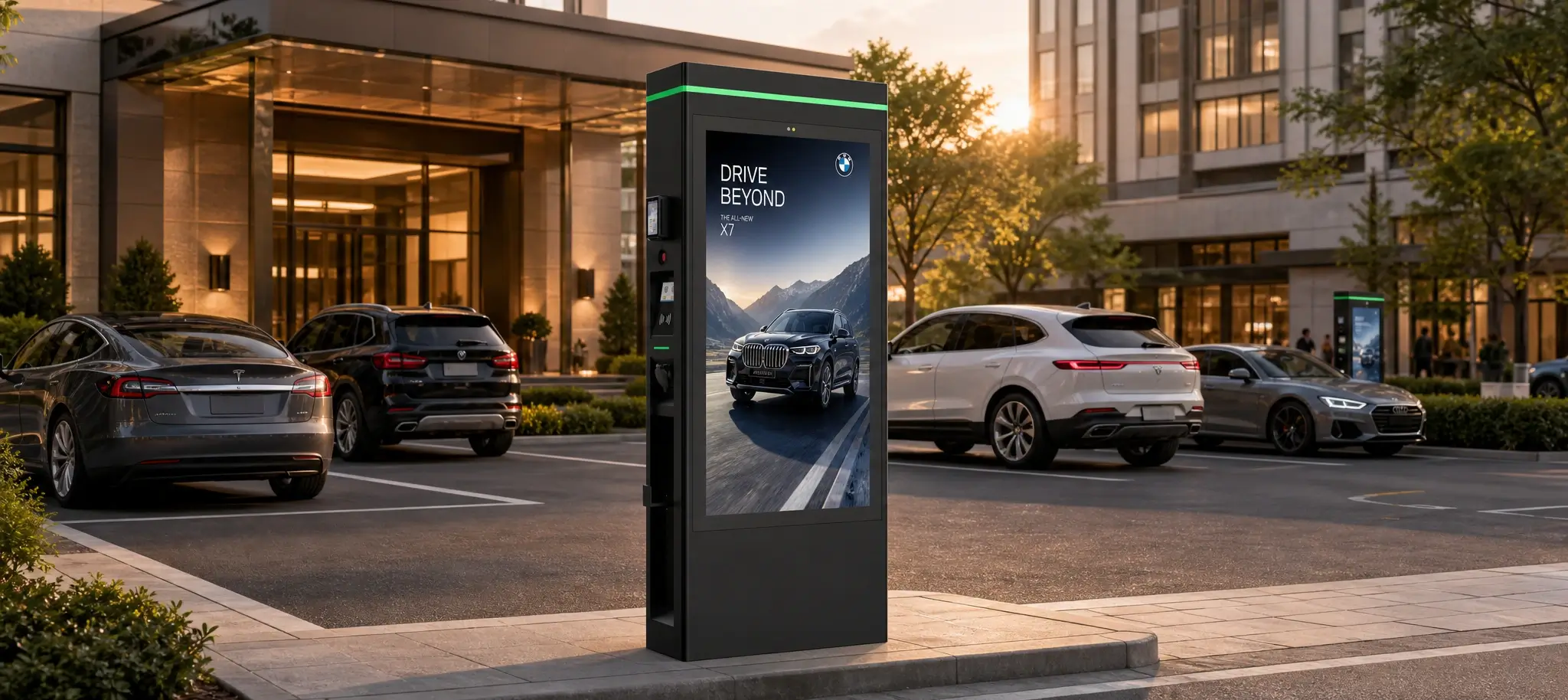
Hardware Layer: Purpose-Built Outdoor Display Subsystem
At the physical level, advertising chargers rely on a dedicated display subsystem that operates alongside the core charging hardware.
High-brightness outdoor LCD panel: Commercial models use 43” or 55” IPS panels with brightness ratings of 2500–3500 cd/m², ensuring visibility in direct sunlight. Panels support 178° viewing angles and have a rated lifespan of 50,000 hours.
Independent media control unit: A dedicated Android-based quad-core processing unit handles media decoding and playback, with 2GB RAM and 8GB of expandable on-board storage. It supports all common video, image, and audio formats.
Environmental hardening: The display assembly and media unit are enclosed within an IP55-rated housing, with topple protection and an operating temperature range of -30°C to +55°C for year-round outdoor deployment.
System Layer: Safety-Decoupled Dual Architecture
A defining feature of commercial-grade advertising chargers is the full isolation between the charging control system and the media system.
The charging control subsystem runs independently, managing power conversion, safety protection, vehicle communication, and OCPP protocol connectivity. It prioritizes real-time reliability and functional safety.
The media playback subsystem runs on a separate hardware and software stack, responsible for ad scheduling, content rendering, and display management.
This physical and logical decoupling ensures that media system crashes, updates, or faults never interfere with core charging functions, maintaining the safety and availability that charging infrastructure requires.
Content Delivery Layer: Cloud CMS and Offline Resilience
Advertising content is managed and distributed through a cloud-based content management system.
Centralized cloud platform: Operators can upload creative assets, build playback schedules and target content to specific chargers, sites or regions. Timed playback, daypart scheduling and split-screen configurations are all managed remotely.
Multiple delivery channels: Content can be pushed over Ethernet, Wi-Fi or 4G cellular connectivity. For sites with limited connectivity, local updates via USB flash drive or SD card are also supported.
Offline playback capability: Media content is cached locally on the charger, so advertising playback continues uninterrupted during network outages.
Presentation Layer: Session-Aligned Display Logic
On-screen behaviour is synchronized with the charging session to balance user experience and advertising yield.
In standby mode, the screen runs full-screen advertising content.
When a charging session starts, the system can switch to a split-screen layout, showing real-time charging data on one portion of the screen while advertising continues on the other.
Safety alerts, fault messages, and emergency notifications always take display priority over advertising content.
Layouts support full-screen, landscape, portrait, and custom split-screen configurations to match different site orientations and brand requirements.
Key Considerations for Advertising EV Charger Deployment
Outdoor Durability and Environmental Compliance
Prioritize chargers with IP55 or higher ingress protection, wide operating temperature ranges, and high-luminance displays rated for direct sunlight. IK impact ratings and anti-topple construction reduce vandalism risk and extend service life in high-traffic public locations.
Functional Safety Independence
Verify that the advertising media subsystem is fully decoupled from the charging control path. Media software failures must never disrupt charging operation or safety functions. All charging hardware should carry CE, UL, and TUV certifications aligned with your target market.
Centralized Operational Efficiency
Select solutions with a unified cloud management platform that handles both charging operations and advertising content management. Centralized monitoring, bulk content updates, and remote diagnostics reduce on-site maintenance and lower operational overhead for multi-site networks.
Market-Specific Certification and Compliance
For European deployments, ensure compliance with EN/IEC 61851 standards, CE marking, and MID-certified metering. For North America, look for UL 2202 and UL 2594 certification. Advertising content and data handling must also adhere to regional privacy and advertising regulations.
Site and Monetization Matching
Advertising revenue scales with foot traffic and dwell time. High-retention locations such as retail centres, highway service areas and destination parking lots deliver the strongest ad ROI. Match charger power class and screen size to site traffic, audience profile and available grid capacity.
Zeconex Advertising EV Charging Solutions
Portfolio Overview
Zeconex manufactures a complete line of advertising-integrated EV chargers covering both AC and DC power classes, engineered for commercial public deployments across Europe and North America. Built on safety-decoupled dual-system architecture, the portfolio delivers dependable charging performance alongside flexible advertising monetization, making it suitable for retail centres, highway stations, fuel retail locations and urban public parking projects.
Core Product Lines and Specifications
Commercial Advertising AC Chargers (14–44kW)
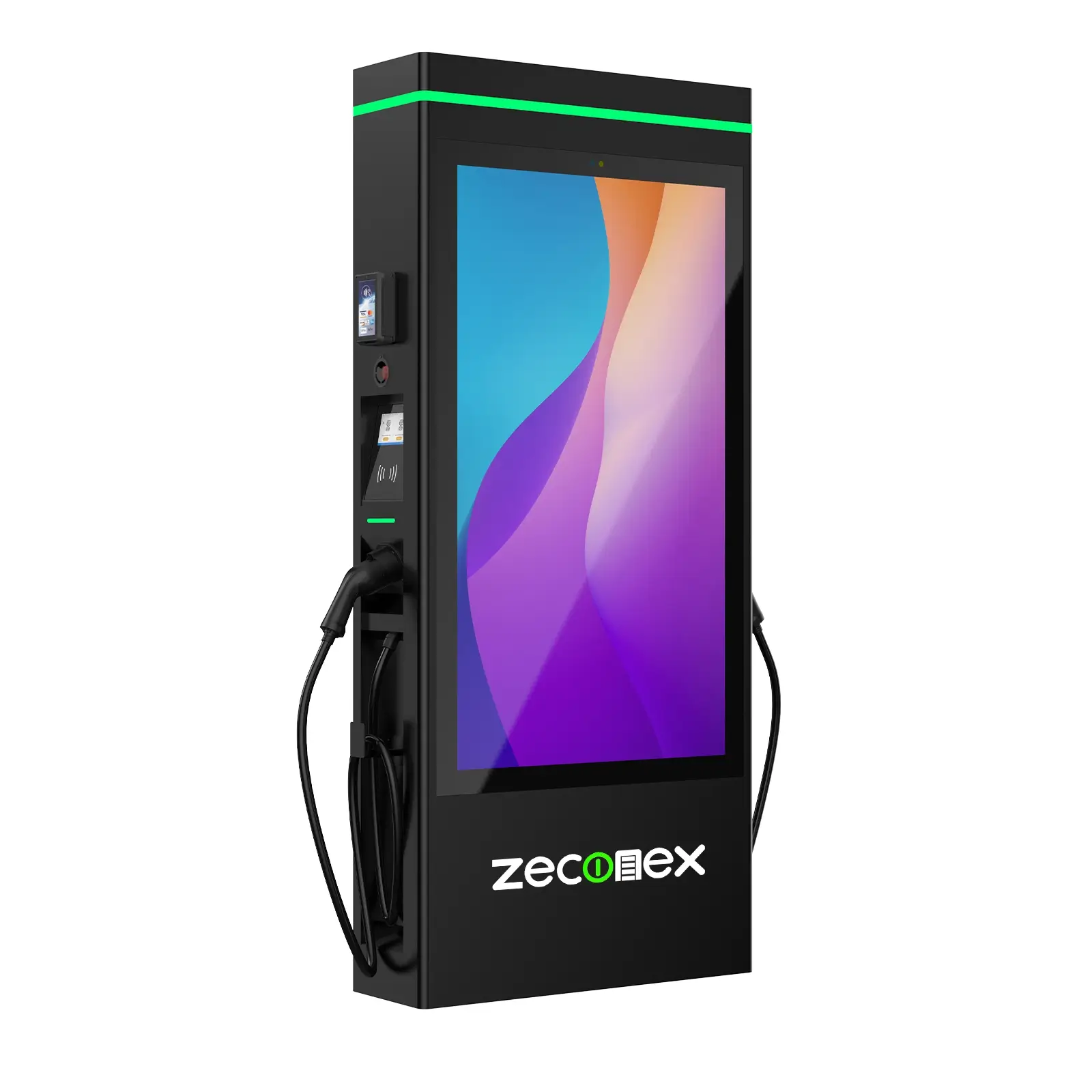
Commercial advertising AC chargers (14–44kW) dual-port floor-standing charging stations integrated with a 55” 2500 cd/m² high-brightness IPS display, purpose-built for monetizing public charging foot traffic.
Supports remote cloud-based ad content updates and multiple media formats (video, image, audio), with IP55 weather resistance and topple protection for reliable 24/7 outdoor operation. Delivers dual revenue streams from both charging services and digital advertising, ideal for commercial parking lots and retail sites.
Commercial Advertising DC Chargers (60–180kW)
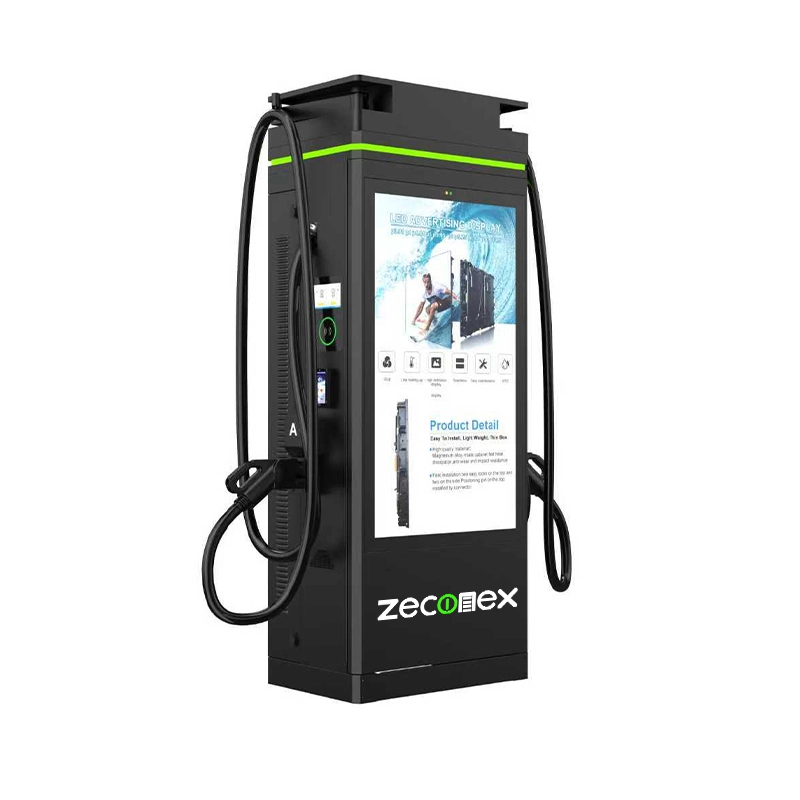
Commercial advertising DC chargers (60–180kW) dual-gun fast charging stations engineered for high-traffic public sites, combining high-speed DC charging with high-impact digital advertising to unlock dual revenue streams per location.
Available with 43” or 55” high-brightness outdoor displays, they run on an Android-based quad-core media subsystem with expandable storage, supporting a full range of video, image and audio ad formats. Operators can update content remotely via the cloud or locally via USB/SD card, with flexible split-screen and orientation modes to customise campaign layouts.
Optional POS payment terminals enable seamless on-site transactions, while industry-standard certifications and comprehensive safety protection deliver dependable 24/7 outdoor operation with minimal maintenance.
Advantages for Commercial Deployments
- 10+ years of in-house R&D and manufacturing expertise spanning charging hardware, embedded software, and cloud management systems
- Full OEM/ODM customization support for branding, user interface, and functional configuration, with white-label solutions available
- Stable production capacity with 5–7 day sample lead times and 30–40 day mass production delivery
- End-to-end technical support covering protocol integration, system docking and after-sales service
Zeconex Advertising EV Charging Solutions
Advertising-enabled EV chargers combine rugged outdoor display hardware, a safety-isolated media subsystem and cloud-based content management to turn charging infrastructure into multi-revenue digital assets. By diversifying income streams beyond charging fees, these solutions shorten project payback cycles and create lasting value for charge point operators and site owners.
With a decoupled architecture that prioritizes charging safety alongside advertising flexibility, well-specified advertising chargers represent a high-ROI path for building future-proof commercial EV charging networks.