
ZECONEX frequently receives certification-related inquiries from buyers in Canada, the United States, the United Kingdom, Australia, and New Zealand. These inquiries often involve requirements such as UL, CSA, ETL, UKCA, RCM, and AS/NZS. One common question is: If an EV charger already carries the CE mark, does it meet the requirements for installation and use in other countries?
The answer is not always yes. Different countries and regions have their own product safety standards and compliance requirements. Although CE marking, IEC test reports, and CB documents can provide technical evidence of product compliance, they do not necessarily replace local certification required by the target market.
This article outlines the common EV charger certification requirements in major markets and explains the role of different test documents in cross-market compliance.
What Certifications Are Required for EV Chargers in Different Countries?
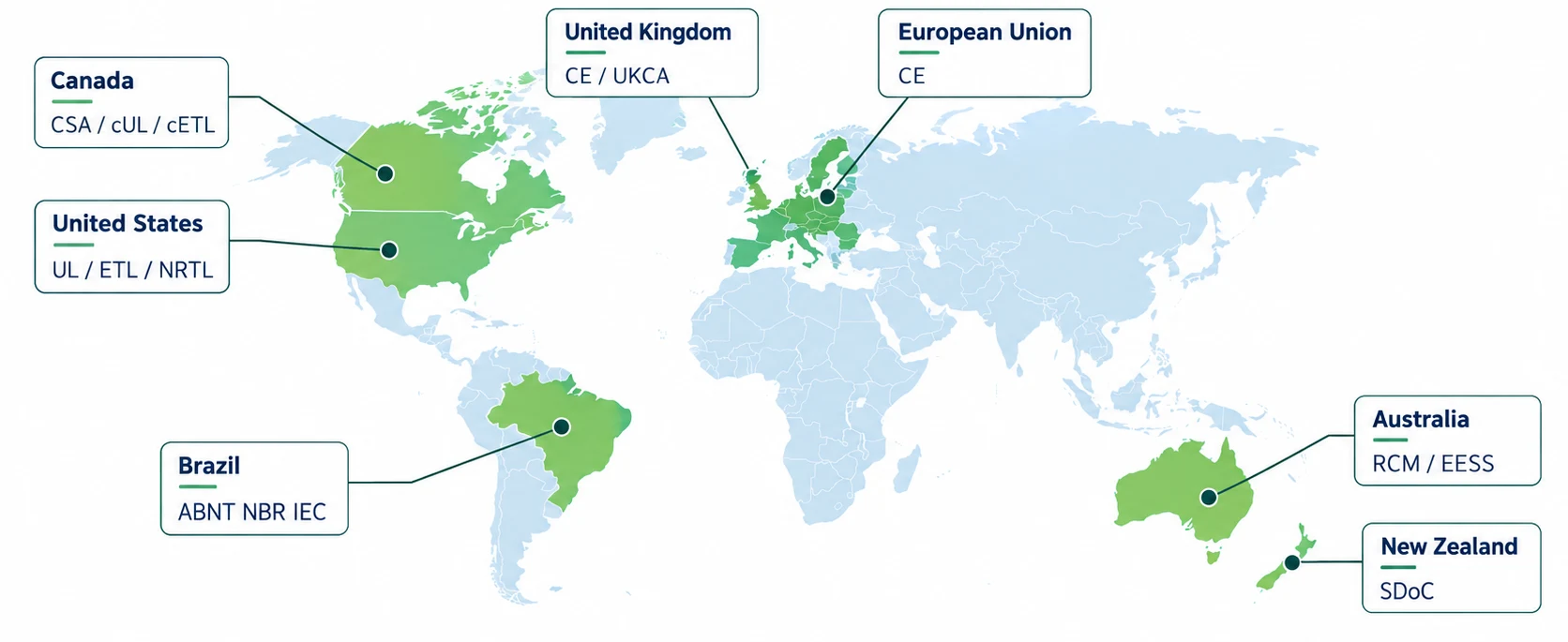
The following table summarizes common certification or compliance marks in major export markets.
Target Market | Common Certification or Compliance Marks | Description |
|---|---|---|
European Union | CE | Indicates conformity with applicable EU legislation and requirements |
United States | UL, ETL | Common product safety certification marks; applicable NRTL requirements must be met |
Canada | CSA, cUL, cETL | Common electrical safety certification marks for the Canadian market |
United Kingdom | CE, UKCA | Requirements depend on the product category and applicable regulations |
Australia | RCM, EESS | Requirements depend on equipment classification and applicable electrical safety regulations |
New Zealand | SDoC and applicable test documentation | Requirements depend on local electrical safety regulations and applicable EVSE standards |
Brazil | ABNT NBR IEC and others | Compliance depends on applicable technical standards and local requirements |
Please note that these are common certification or compliance marks in each market. They do not mean that every EV charging product is subject to the same requirements. The applicable requirements depend on the product type, rated specifications, and regulations of the target market.
Can CE Marking or IEC Test Reports Replace Local Certification?
This is one of the most common questions when exporting EV chargers.
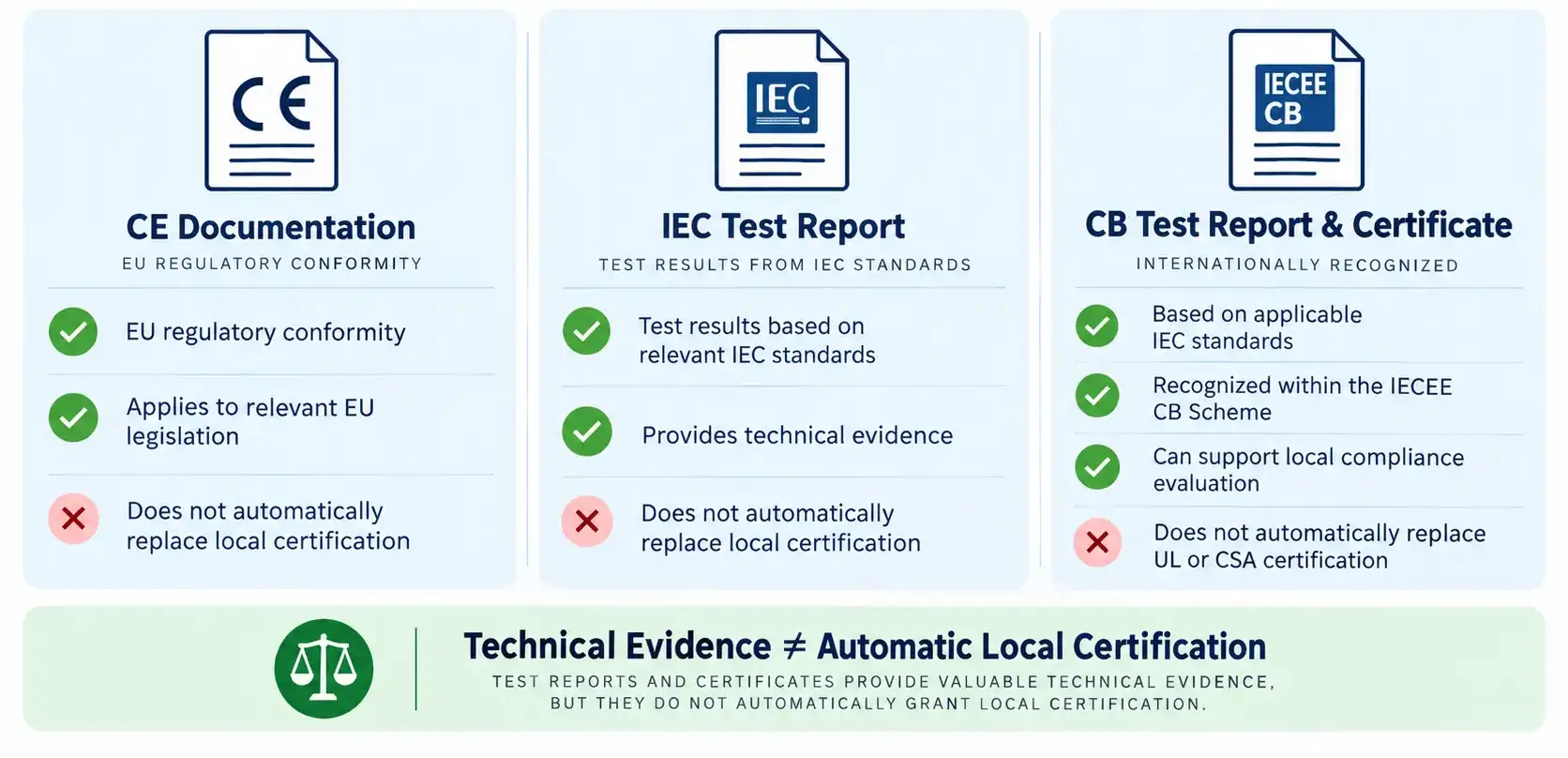
The short answer is: CE documentation, standard IEC test reports, and CB test reports and certificates cannot automatically replace local certification required by the target market. However, they can serve as technical evidence of product compliance to varying degrees.
Each type of documentation serves a different purpose.
Existing Documentation | Main Purpose | Can It Directly Replace Local Certification? |
|---|---|---|
CE documentation | Demonstrates conformity with applicable EU legislation | Generally no |
IEC test report | Provides test results based on relevant IEC standards | Cannot automatically replace it |
CB test report and certificate | Provides product safety test evidence that can be referenced by certification bodies in participating CB Scheme countries and regions | Cannot automatically replace it, but can support local compliance evaluation |
CB documentation differs from a standard IEC test report. The CB Scheme is based on relevant International Electrotechnical Commission (IEC) standards. Its test results may be used as a reference by certification bodies in participating countries and regions. However, acceptance and any additional testing requirements depend on the specific requirements of the target market.
Are Existing Test Documents Useful If the Product Does Not Have Local Certification?
Not having local certification does not mean that existing test documentation has no value. However, CE marking or an IEC test report alone does not mean that a product is automatically approved for entry into a local market.
The situation depends on the documentation available.
If the Product Has a CB Test Report and Certificate
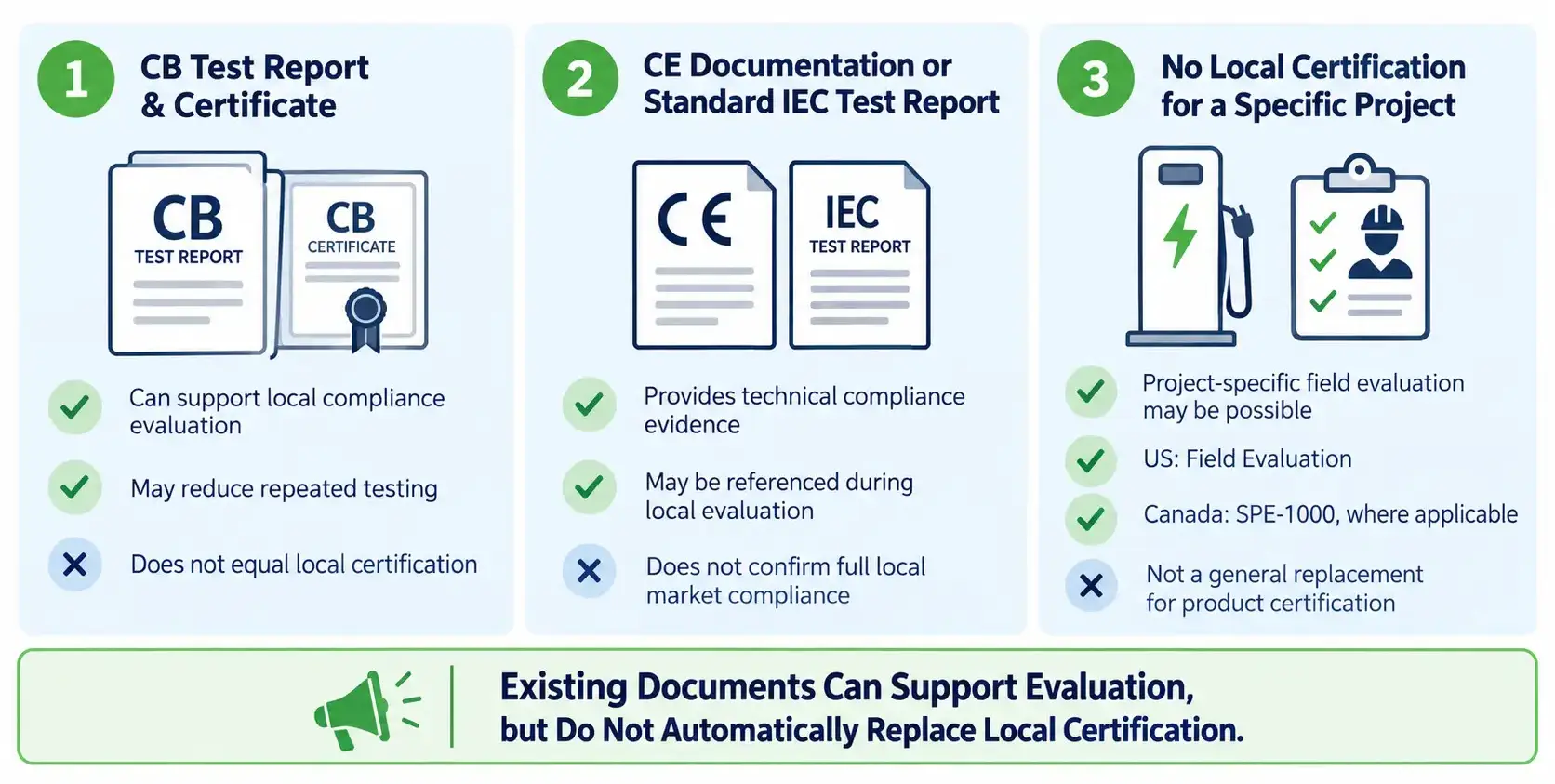
CB documentation can provide a more comprehensive basis for evaluating product compliance in the target market. In countries participating in the CB Scheme, relevant test results may be referenced by local certification bodies, potentially reducing the need for repeated testing.
However, CB documentation itself is not equivalent to a UL, CSA, or other local certification mark.
If the Product Only Has CE Documentation or a Standard IEC Test Report
These documents can demonstrate that the product meets certain applicable regulatory or technical standard requirements. However, they do not confirm that the product meets all certification requirements in markets such as the United States, Canada, or Australia.
Whether these documents can be used in a local compliance evaluation depends on the specific standards and requirements of the target market.
If the Product Has No Local Certification but Is Intended for a Specific Installation Project
For certain projects, project-specific field evaluations or special inspections may be possible where permitted by the relevant local authorities.
Examples include Field Evaluation in the United States and the SPE-1000 special inspection procedure in Canada, where applicable. These options are limited to specific project conditions and should not be considered general local certification alternatives for products intended for mass distribution.