

As the electric vehicle market continues to grow, the demand for high-quality charging equipment is increasing. More businesses and buyers are now asking a key question: how are EV chargers manufactured? From core electronic components to final assembly, the manufacturing process involves multiple critical stages that directly impact performance, safety, and reliability. As a professional EV charging solutions provider, Zeconex takes you through the complete manufacturing process.
EV Charger Design & Development
The engineering team first defines product positioning, including power range, input/output parameters, and application scenarios.
Based on these requirements, the system architecture is developed, covering power electronics topology selection (such as rectification, PFC, and DC/DC conversion) as well as PCB design and layout for both control and power boards.
Key components, including IGBT/MOSFETs, capacitors, inductors, and relays, are then selected, with a complete BOM prepared and validated through electrical and thermal simulations to ensure circuit stability and effective heat dissipation.
Structural Design
The enclosure dimensions, internal layout, and protection structure are designed based on the installation method, such as wall-mounted or pedestal configurations.
Software Development
The control logic is developed, and communication modules (such as 4G or Ethernet) are configured. At the same time, OCPP protocol integration is implemented to ensure the device can connect to backend management systems.
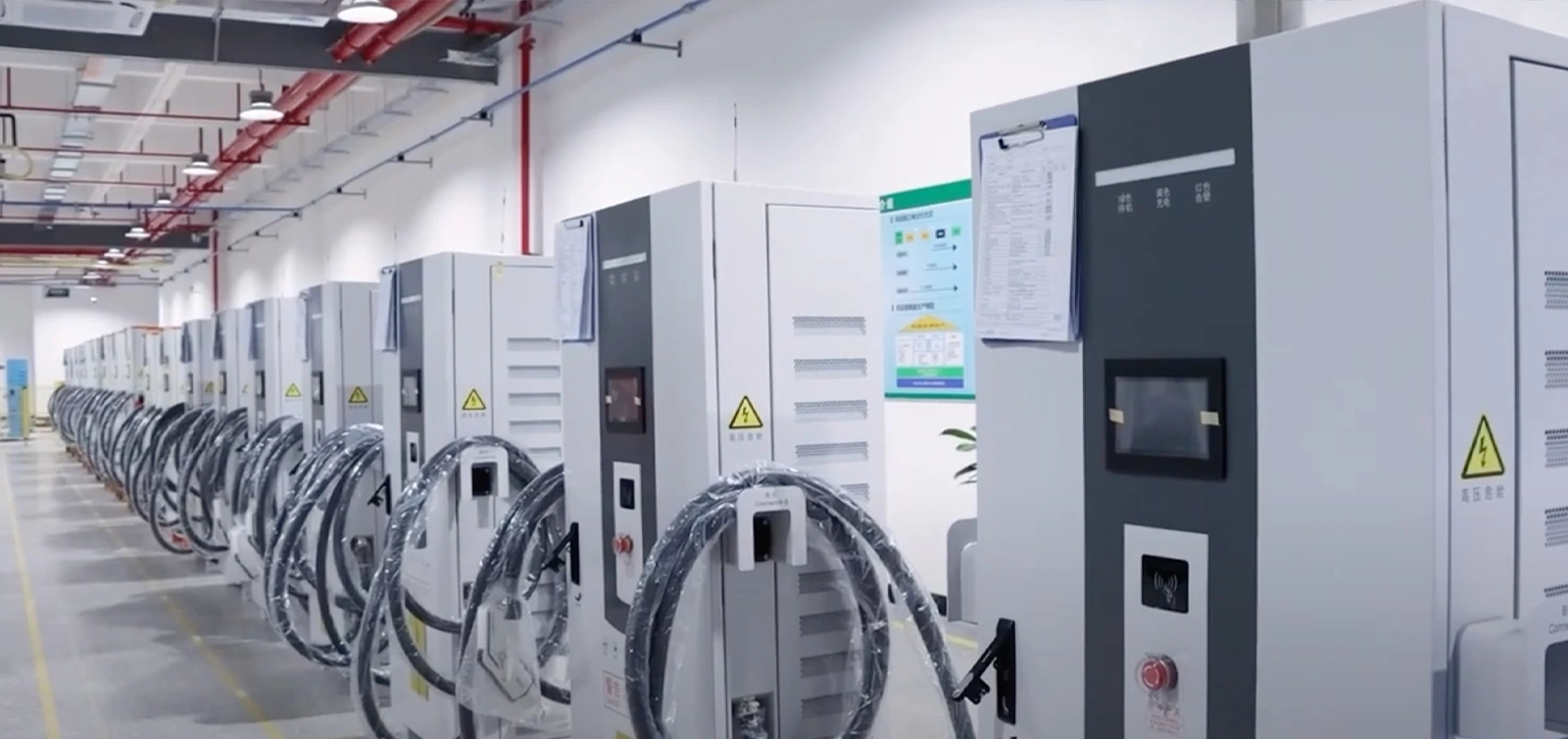
Key Components in EV Charger Manufacturing
EV chargers are typically built around key components, including power modules, control systems, power supplies, charging connectors, and wiring harnesses. In actual production, the choice of core power devices, like IGBTs or MOSFETs, depends on the required power level. These are then integrated with an MCU to manage the control logic, along with protection elements such as relays and contactors to ensure safe and stable operation.
Charging connectors (such as Type 2, CCS, or GB/T) and cables are then selected to meet relevant standards. Other components, including capacitors, inductors, sensors, and connectors, are chosen and matched according to electrical design requirements.

EV Charger Hardware Integration
1. PCB Assembly & Electronics Manufacturing
PCB assembly and electronic component manufacturing are critical for implementing control and signal processing in electric vehicle chargers, directly affecting system stability, signal accuracy, and overall reliability.
By precisely mounting and integrating various electronic components according to circuit designs, while rigorously controlling soldering quality and electrical connection consistency, and performing fundamental electrical testing and quality verification, the circuitry is ensured to operate stably and meet the requirements for subsequent full-system integration.
2. Power Module Integration
The modules responsible for energy conversion and output in electric vehicle chargers directly affect charging efficiency, thermal management, and the system's overall operational stability and safety.
By integrating power devices such as IGBTs or MOSFETs with cooling structures, busbars, and high-voltage connection systems, while optimizing thermal conduction paths, current transmission efficiency, and electrical safety clearances, and performing fundamental power-on and load testing, stable power output can be ensured to meet the full-system performance requirements.
3. Mechanical Structure Fabrication
The charger’s enclosure and support are designed for maximum protection, ensuring water and dust resistance, environmental adaptability, and long-term durability. Optimized housing, internal layout, and sealing, combined with precision sheet metal fabrication and surface treatments, along with appropriate installation options (wall-mounted or pedestal), deliver excellent heat dissipation and lasting performance.
4. Final Assembly Process
All functional modules are integrated in the order of the assembly sequence. First, the control system and power modules are installed and secured, followed by wiring harness connections and interface mating.
Critical connection points are carefully inspected and organized to ensure tidy routing and reliable connections. During assembly, particular attention is given to wiring accuracy, interface tightness, and high- and low-voltage isolation to prevent misconnection, looseness, or interference risks.
Software Integration & OCPP Configuration
Software integration and OCPP configuration enable the charger to connect to networks and management platforms, supporting remote monitoring and operations.
This involves loading the control software and configuring communication protocols so the charger can interface with backend systems and exchange data.
During testing and commissioning, device online status, command response, and data transmission are repeatedly verified, with particular attention to connection stability and protocol compatibility to prevent disconnections, delayed responses, or data errors. Only after successful system integration and validation can the charger meet real-world operational and management requirements.

Quality Inspection and Testing
Before leaving the factory, the charger undergoes comprehensive verification of its functionality, performance, and safety. This typically includes power, on tests, functional tests, load tests, and aging tests to confirm the device’s performance under various operating conditions. During testing, special attention is given to electrical protection, temperature rise, and operational stability to ensure the charger meets factory standards and delivers reliable performance.
Certification & Compliance Standards
To meet target market requirements, the charger undergoes relevant certification testing and standard audits, such as CE, UL, or applicable IEC standards, to verify compliance in electrical safety, electromagnetic compatibility, and environmental adaptability. Early planning of testing and certification processes helps prevent delays caused by standard mismatches or incomplete documentation.
Packaging, Delivery & Installation Preparation
Before shipment, the charger’s packaging strength and protective measures (shock and moisture protection) are verified to prevent damage during transport. The completeness of the included accessories, such as the charging connector, cables, mounting brackets, and fasteners, is also checked to ensure that no items are missing or mismatched.
Relevant technical documentation, including installation instructions, wiring diagrams, and basic operating guides, is prepared to enable quick on-site deployment. Additionally, installation conditions (power supply interface, available space, and structural foundation) are confirmed in advance to avoid delays caused by site incompatibility. Thorough preparation and inspection ensure the equipment can be delivered smoothly and put into operation quickly.
Conclusion
Before shipment, the charger’s packaging strength and protective measures (shock and moisture protection) are verified to prevent damage during transport. The completeness of the included accessories, such as the charging connector, cables, mounting brackets, and fasteners, is also checked to ensure that no items are missing or mismatched.
Relevant technical documentation, including installation instructions, wiring diagrams, and basic operating guides, is prepared to enable quick on-site deployment. Additionally, installation conditions (power supply interface, available space, and structural foundation) are confirmed in advance to avoid delays caused by site incompatibility. Thorough preparation and inspection ensure the equipment can be delivered smoothly and put into operation quickly.