
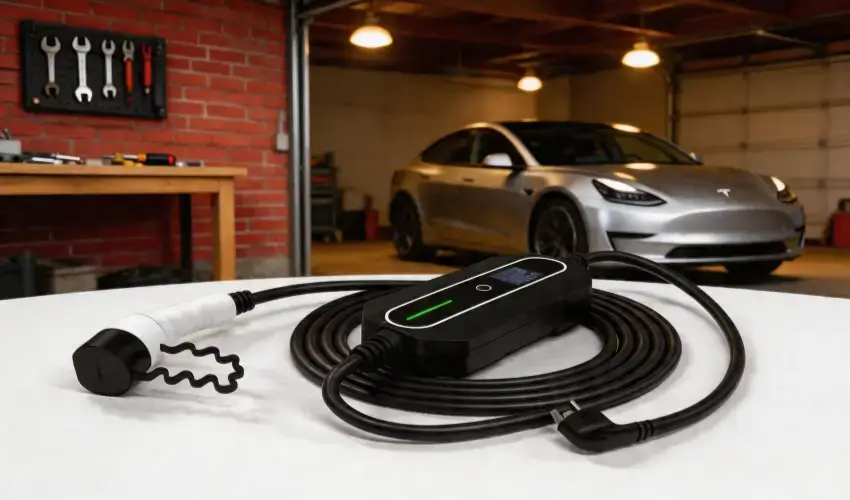
Yes, portable EV chargers are a practical solution when you don’t have access to a fixed charging station.
No one buys an electric vehicle just to wrestle with a flimsy extension cord from the 90s every weekend. When your range is running low, and the only power source is an outdated outlet in the corner of a barn, a portable charger is what actually gets you moving again.
It’s far more reliable than the basic emergency cable that comes with the car—plug in and charge, no hassle.
Keep reading. With 12 years of hands-on experience in charging solutions, ZECONEX breaks down what truly defines a dependable portable EV charger, and the core capabilities that actually matter.
What Is a Portable EV Charger Exactly?
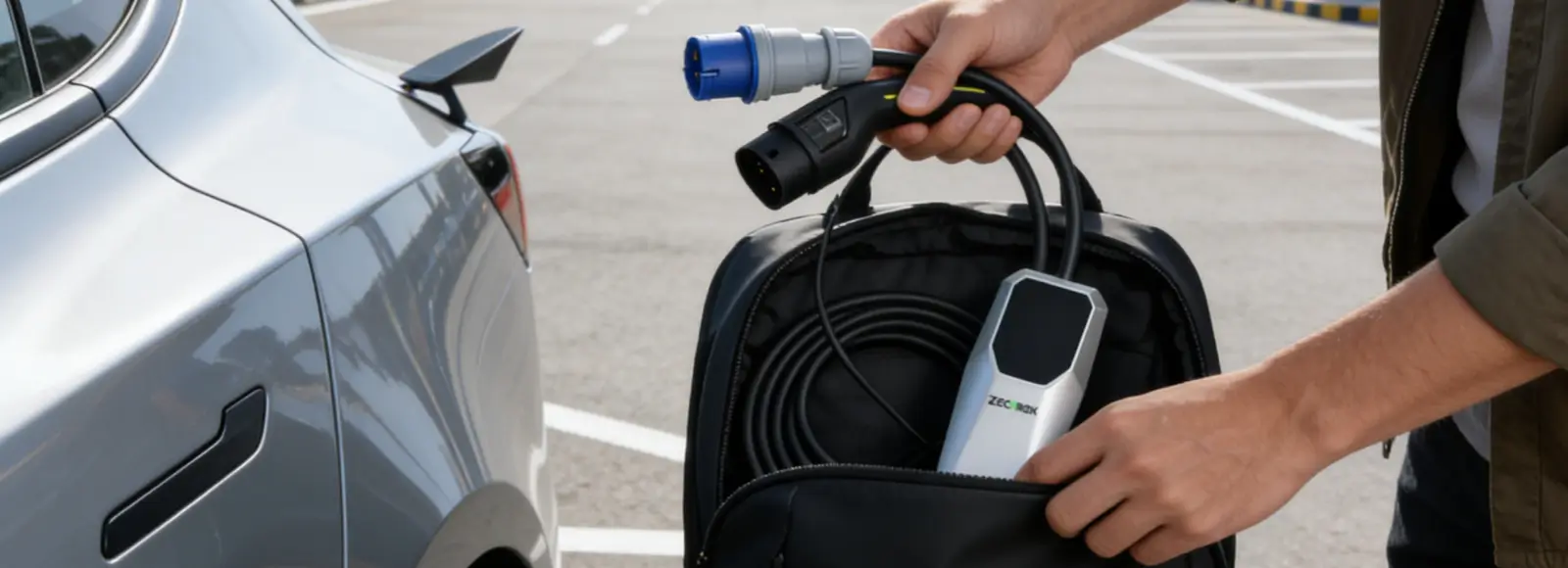
Before getting into specs, one thing needs to be clear: a portable EV charger is not the same as a basic Mode 2 emergency cable. The latter usually comes with the vehicle, has limited power output, and is only meant for backup use when no other charging option is available.
A true portable EV charger is a standalone device that integrates a control unit, full protection systems, a user interface, and a rugged enclosure. Key features typically include:
Adjustable charging current: allowing users to match the output to the capacity of the outlet
Comprehensive electrical protection: including over/under voltage, overcurrent, overtemperature, and residual current protection
Outdoor durability: designed with high-level dustproof, waterproof, and impact resistance for mobile use
Take the ZECONEX home AC portable charger as an example. Its dimensions are approximately 210 mm × 88 mm × 50 mm—roughly the size of a standard lunchbox. It fits easily into a trunk storage compartment without taking up extra space.
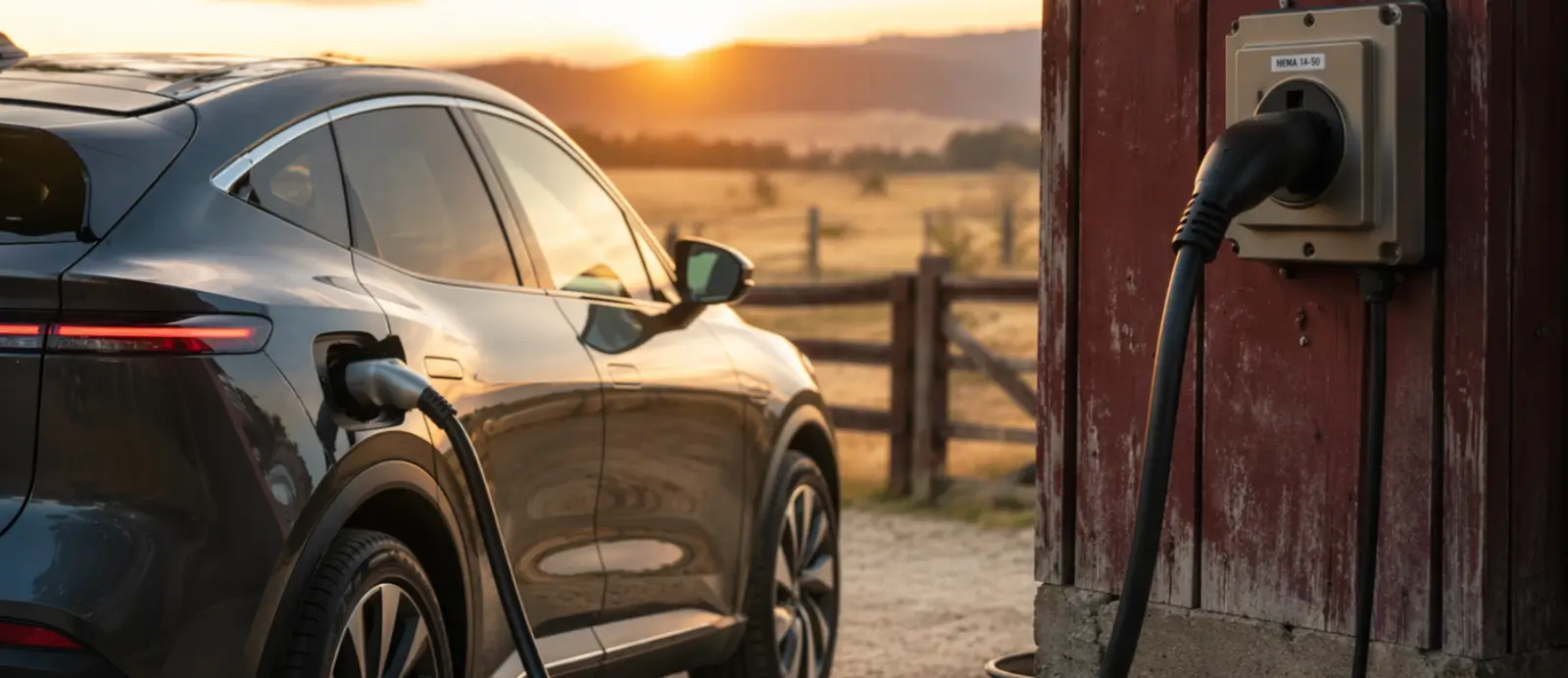
Picture this: you’re spending the weekend at your father-in-law’s farm in Texas. The only available power source is a NEMA 14-50 outlet installed back in the late ’80s, tucked away in the corner of a barn. You plug in the ZECONEX portable charger, set the current, and by morning, your vehicle is fully charged and ready to go. That’s the real value here—turning EV charging from something you have to plan around into something you can do anywhere there’s a usable outlet.
Power Ratings, IP Protection, and Smart Control
Power output in a portable EV charger isn’t about “the higher, the better.” It needs to match both the available power supply and the vehicle’s onboard charger specifications.
The following categories reflect typical power ranges based on current market data for EV chargers.
1. Single-Phase AC Input (3.5 kW – 7 kW)
This is the most common portable charging solution for everyday use.
- Electrical specifications: rated input voltage of 230V AC ±20%, 50/60Hz, single-phase. Adjustable output current options typically include 8A / 10A / 13A / 16A / 32A.
- Charging time reference: For example, with a 7 kW EV charger, a 60 kWh battery would take approximately 8.5 hours to fully charge from empty under ideal conditions—well-suited for overnight charging.
2. Three-Phase AC Input (11 kW – 22 kW)
Designed for residential or commercial locations with access to a three-phase power supply.
Electrical specifications: rated input voltage of 400V AC ±10%, 50/60Hz, three-phase. Adjustable output current levels typically include 6A / 8A / 10A / 13A / 16A / 20A / 24A / 32A.
Load-adaptive protection: temperature sensors are integrated at the input and power relay sections. When the system detects that the outlet or cable temperature exceeds a preset threshold (e.g., 70°C), the control unit automatically reduces the output current to a safe level (such as 6A). If the temperature rises to a critical point (e.g., 75°C), charging is shut down completely. This mechanism effectively reduces the risk of overheating-related failures, especially in older electrical installations.
3. Enclosure Protection & Mechanical Durability
- IP66 protection rating: in accordance with IEC 60529, this means complete protection against dust ingress and resistance to powerful water jets (flow rate of 100 L/min, pressure of 100 kPa, with a test duration of at least 3 minutes). It remains reliable even in heavy rain or snow.
- IK10 impact resistance: based on IEC 62262, the enclosure can withstand an impact energy of 20 joules—equivalent to a 5 kg object dropped from a height of 40 cm. This provides effective protection against accidental impacts during transport and everyday use.

Portable DC Chargers: Mobile Fast Charging Explained
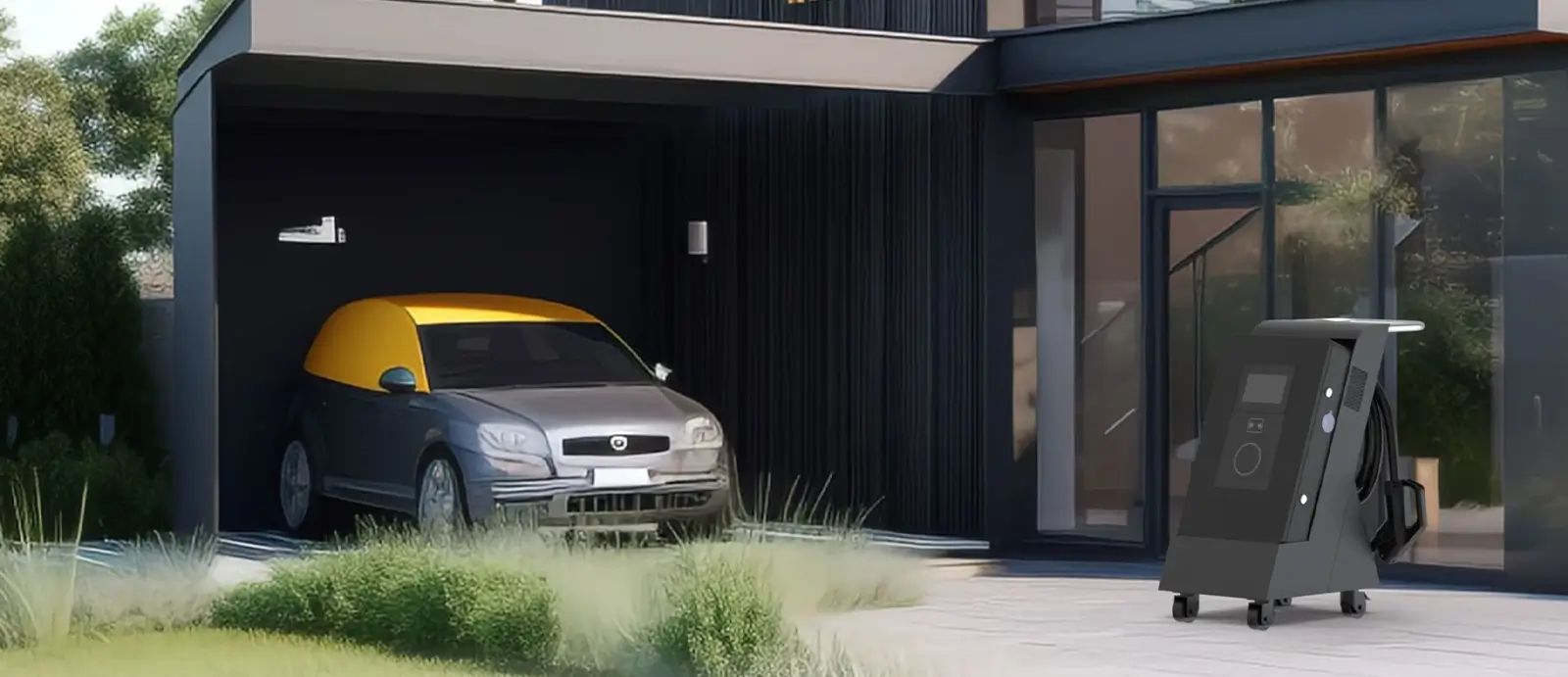
For applications that require faster charging, the power ceiling of home portable AC chargers may not be sufficient. In these cases, portable DC chargers offer a more targeted solution.
These units integrate an onboard AC/DC conversion module, allowing them to deliver DC power directly to the vehicle’s battery—bypassing the onboard charger. The ZECONEX portable DC product range typically covers 30 kW to 40 kW, with customized models reaching 60kW to 80 kW, and BESS-integrated versions up to 120 kW. The output voltage range is generally 150V–1000V DC.
The trade-off is weight. Most portable DC chargers weigh between 35 kg and 90 kg, which means transportation usually requires a pickup truck or service vehicle. As a result, they are not practical for everyday use in private passenger cars. Typical use cases include roadside emergency support—providing fast charging for stranded vehicles—as well as temporary commercial setups, such as event shuttle fleets or outdoor machinery that require short-term charging without permanent infrastructure.
If portable AC charging is like carrying your own supplies, portable DC charging is more like bringing a mobile kitchen—less convenient to move, but capable of solving much bigger problems when it counts.
Certifications, Safety Features, and Compatibility Guide
When selecting a portable EV charger, safety and compliance should be the top priorities. The following are three key criteria to evaluate.
1. Market Access Certifications
Products should meet the mandatory or recommended certification requirements of the target market. Common examples include:
CE (European Union)
UKCA (United Kingdom)
FCC (U.S. Federal Communications Commission)
UL 2594 / UL 2231 (North American electrical safety standards)
These certifications indicate that the product complies with local regulations for electrical safety, electromagnetic compatibility, and related requirements.
2. Residual Current Protection Type
During EV charging, smooth DC residual currents may occur, which standard Type AC residual current devices cannot reliably detect.
Therefore, a portable EV charger should be equipped with either a Type AC 30 mA protection device or an RCMU (Type A + 6 mA DC) residual current detection and protection module, ensuring that the power supply is safely disconnected in the event of a fault.
3. Ground Continuity Monitoring & Fault Handling
In older buildings or remote locations, the grounding system may be missing or unreliable. A compliant portable EV charger should include protective earth (PE) continuity detection and allow activation of a no-ground charging mode via a physical override when a grounding fault is present.
In addition, if relay contacts inside the unit become welded or stuck, the system should trigger a fault alarm and disable charging to prevent unsafe operation.
4. Additional Electrical Protection Features
A comprehensive protection system should also include overvoltage/undervoltage protection, overfrequency/underfrequency protection, overcurrent protection, overtemperature protection, and surge protection.
Conclusion
A portable EV charger is not a replacement for a home charging station—it’s a practical complement to fixed infrastructure. It provides a way to access power in non-standard situations, whether that’s an old outlet in a rural barn, a distribution box at an outdoor campsite, or a temporary residence without a dedicated charger.
For EV owners who frequently travel across regions or have limited access to home charging, carrying a properly certified portable charger with comprehensive safety protections is a practical way to reduce charging uncertainty.
If you have questions about model compatibility or electrical specifications, feel free to contact the ZECONEX technical team. Based on your vehicle type, typical charging scenarios, and local grid conditions, we can recommend a suitable configuration.