
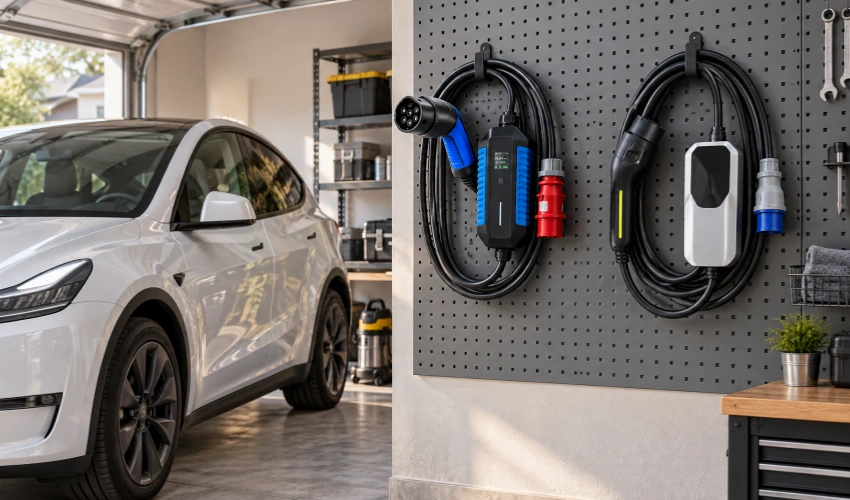
Running out of charge does not always mean you need to find a fixed public charging station. Depending on the available power source, vehicle connector, charging speed, and operating environment, an EV can also be charged with portable or mobile charging equipment.
This can be particularly useful when a home does not have a permanent wallbox, a fleet needs temporary charging capacity, a vehicle requires roadside assistance, or a project site has limited grid capacity.
The important point is that charging an EV without a fixed charging station does not mean charging without a power source. You still need a safe and suitable electrical supply or a battery energy storage system, together with charging equipment that matches the vehicle.
EV Charging Without a Fixed Charging Station
An EV can be charged without a fixed charging station by using a certified portable AC charger connected to a compatible power outlet, a three-phase portable AC charger, a relocatable DC charger connected to suitable upstream power, or a battery-buffered mobile charging system. Each approach requires a suitable energy source, compatible charging interface, and appropriate electrical protection.
The best solution depends on what you have available at the charging site.
For example, a traveler with access to a suitable 230 V outlet has very different requirements from a fleet operator with a 400 V three-phase supply. Likewise, a roadside service provider may need DC charging, while a temporary construction site may benefit from battery-buffered charging.
Four Portable EV Charging Solutions
3.5-7 kW Portable AC Charging

A portable AC charger is one of the simplest ways to charge an EV without a permanently installed wallbox. It connects to a suitable AC outlet, while the vehicle’s onboard charger converts the AC power into DC energy for the battery.
For situations where portability is more important than charging speed, 3.5–7 kW portable AC charging can provide a practical alternative to fixed charging equipment. ZECONEX portable AC chargers support 230 V single-phase input, adjustable charging current, and IP65 protection, making them suitable for flexible charging in different locations.
Available plug configurations vary by model and market, allowing the charger to be used with compatible AC outlets.
11-22 kW Three-Phase Portable AC Charging
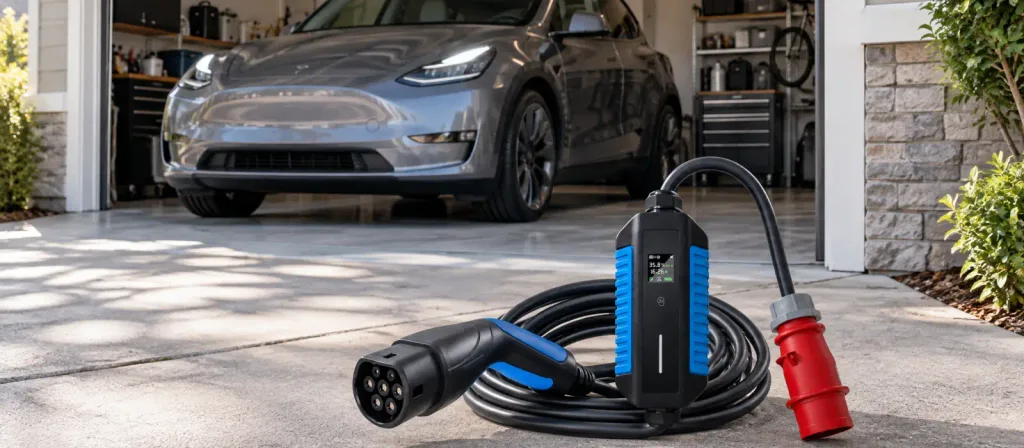
When more charging power is needed, and a three-phase electrical supply is available, portable three-phase AC charging provides a higher-power alternative to standard portable AC charging.
ZECONEX portable three-phase AC chargers support up to 11 kW and 22 kW output from a 400 V three-phase supply. With adjustable charging current and IP66 protection, they can be used in both indoor and outdoor environments.
This type of charger is suitable for workplaces, workshops, construction sites, and other locations where charging equipment needs to be moved between different work areas.
30-40 kW Portable DC Charging
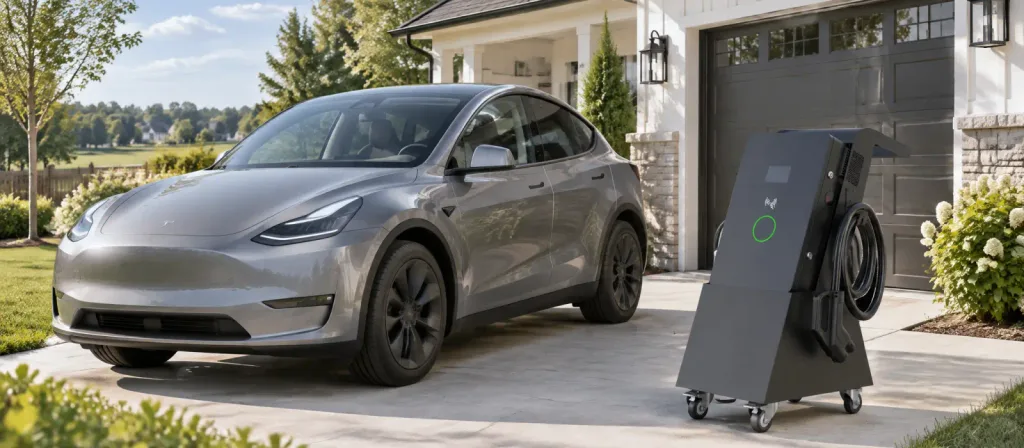
Mobile DC charging provides a higher-power alternative to portable AC charging. Instead of relying on the vehicle’s onboard AC charger, it converts power externally and delivers controlled DC power directly to the vehicle’s high-voltage battery.
With charging power of up to 40 kW, portable DC chargers are suitable for roadside assistance, workshops, dealerships, and temporary charging operations. ZECONEX portable DC chargers support 200–1000 VDC output and multiple vehicle connector options, including CCS2, CCS1, NACS, and GB/T, depending on the model and market.
Battery-Buffered Mobile Charging
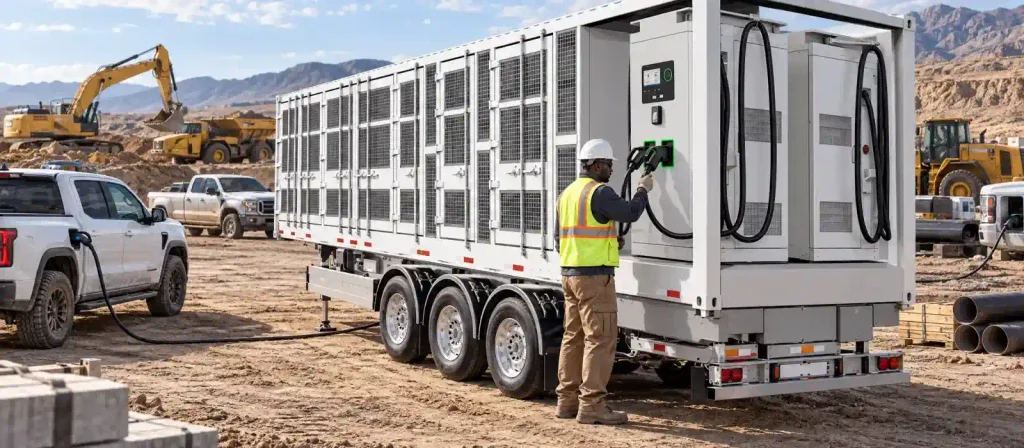
A battery-buffered EV charging system uses a large battery energy storage system (BESS) to store energy before delivering high-power charging to EVs. This reduces reliance on the local grid during charging and can provide additional charging capacity where grid capacity is limited or fixed charging infrastructure is unavailable.
ZECONEX BESS EV Charging Stations are available in 400 kW and 800 kW configurations, with up to 980 kWh and 2050 kWh of usable energy. They support 300–1000 V charging and CCS2 configurations. The ground-mounted systems integrate battery storage, DC charging, fire protection, thermal management, and energy management functions, and can be recharged through AC power, diesel generators, or DC chargers depending on the configuration.
This makes BESS suitable for high-power, temporary, and off-grid EV charging applications.